By Phil Fraser, i-ludus Consulting
The latest reports state that there are now over 1,800 online casinos on the internet. Online sports books proliferate and there seems to be a new online poker site launching every day. One aspect of online gambling that doesn't grab the headlines, but is becoming a vibrant, growing and commercially important market, is online bingo.
"Online bingo? But the little old ladies who play bingo don't have Internet access," I hear you say. That may be the case, but land-based bingo is huge, and it's not only played by little old ladies. In fact, there are more visits to bingo halls in the United States than there are visits to the cinema.
In 1999, the U.S. bingo industry alone had a turnover of $5.1 billion. Add to that the fact that the rules are simple (everyone knows how to play bingo) and that most people don’t even perceive it as gambling and you can see it’s potential.
Multiplayer bingo on the Internet (as opposed to single-player, "keno-bingo") falls into three basic groups: free bingo, game sites with bingo and pay-to-play bingo. Free bingo is offered by a small number of specialist sites. Game play is free and prizes are usually points or small-denomination cash prizes. The operators’ business model is built on banner advertising sales and/or data mining. This is the same model employed by those sites offering a range of games, one of which happens to be bingo. This group includes sites like Pogo, Gamesville and the Flipside Network. The core of the industry, however, is the pay-to-play bingo sites.
 |
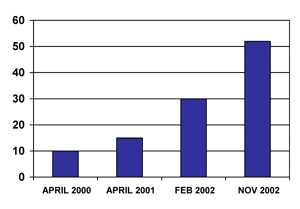
Growth of Pay-to-Play Bingo
Sites
|
Compared to the 1,800 online casinos, the bingo market is small, but it’s growing quickly. There were only 10 credible pay-to-play online bingo offerings in April 2000. A year later this had increased by 50 percent. By February 2002, the number had grown to 30 sites. As I write (November 2002) this figure has risen by more than 60 in less than year; the current count is 52 sites. (All these numbers exclude white-label sites and affiliates.)
The structure of the industry is similar to the online casino industry. Software is licensed to operators, and costs are usually based on an upfront fee plus and on-going, turnover-based royalty. The software used to be supplied by bingo specialists only. Recently, however, two of the online casino world's "big boys"--Boss Media and CryptoLogic--have entered the market as software suppliers.
Again, as with the online casino market, the games come in download, Flash and Java versions, with the download option seemingly returning to favor after an up-turn in Java and Flash in the last year. All pay-to-play bingo sites offer slots games (as per their land-based cousins) but recently there has been a surge of new games on offer, including video poker, keno and other card based games.
Who's playing these games?
We've already established that it's not the "little old ladies" who play land-based bingo. From original research carried out at Which Bingo.com (www.whichbingo.com), it can be seen that the audience is predominantly female (85 percent), two-thirds of them are aged 35-54 , almost all of them are based in North America and over 80 percent of them also play land-based bingo. Interestingly, 40 percent of online bingo players do not take part in any other type of online gambling. For those operators in the online casino market this is great news: Entering the bingo arena will open up new audience streams for them rather than cannibalize their existing player base. If you really want to see what this audience looks like, pop into any bingo site. Most of them have players' galleries so you can indeed see what the audience looks like.
Players galleries may be a strange concept to those used to promoting the benefits of the anonymity of online gaming. Online Bingo is different. One of the main reasons a player will play at one site rather than another is because "their friends play there." That's not friends from the local neighborhood, but friends across the whole Internet. The basis of this community spirit within the bingo games is the chat window. The chat window is open during the game and players interact throughout the game, creating the community atmosphere. This then brings an additional marketing tool into play: the chat host. Simply, the chat host is there (in the chat room) to develop a community atmosphere and offer immediate customer support. A good chat host (or "CM," as they are known) can be the difference between an OK site and a great site. Importantly, they can also be an influence on whether a player returns.
Finally, with the cost of both recruitment and retention within the gaming market remaining competitively high, it's worth looking at bingo in comparison. Taking an arbitrary day, the cost to appear in first position on Overture for the word "casino" is more than three times more expensive than appearing in first position for "bingo." Similarly, the top position for "online casino" is more than five times more expensive than "online bingo." Further, retention levels are much, much higher in online bingo.
Although only a brief overview of the online bingo market, suffice to say that it is a vibrant, fast-growing niche within the online gaming market and one that deserves to be looked at in more depth by anyone looking for an opportunity in online gaming.
i-ludus Consulting offers strategic direction and marketing services to companies looking to develop online gambling businesses, specializing in online bingo. For more information, contact Phil Fraser at pfraser@i-ludus.com or on +44 113 368 0693.